


Why water transport of fruit is safer than mechanical transport
Comparison of transport methods in fruit sorting lines and their impact on quality, damage, and losses.
Fruit transport within a sorting line has a direct impact on final product quality. This is especially critical for apples, which are highly susceptible to bruising, skin micro-damage, and internal defects even before the actual sorting stage.
The transport method directly affects:
- the level of mechanical damage,
- post-harvest shelf life,
- the share of premium-grade fruit,
- overall losses and rejection rate.
In practice, transport itself is one of the main sources of quality loss. More on reducing damage in later stages of the process:
How to reduce apple damage during sorting.
Problem: mechanical damage starts during transport
Damage does not occur only at the sorter. It often starts earlier: during bin unloading, direction changes, transitions between line sections, or contact with hard conveyor components.
The most common consequences include:
- bruises and pressure marks,
- micro-damage that is not immediately visible after sorting,
- damage to the internal fruit structure,
- faster quality deterioration during storage.
That is why the way fruit is fed into the line and moved further through the process matters not only for appearance but also for shelf life. This topic is closely linked to:
How to increase apple shelf life after harvest.
Mechanical transport – where the risk appears
Typical mechanical transport systems such as belts, chutes, or roller conveyors are simple and widely used, but they have several limitations when delicate fruit is involved.
- fruit contact with hard surfaces,
- point pressure on the skin,
- fruit-to-fruit collisions,
- sudden bin discharge and high impact at the beginning of the line,
- uncontrolled drops and abrupt direction changes.
The result is usually predictable: more damaged fruit, lower batch consistency, and a smaller share of fruit that can be sold as premium product.
How water transport (hydrotransport) works
Water transport uses physical properties of liquids that reduce the loads acting on the fruit:
- buoyancy reduces pressure on the fruit,
- water cushions movement and impacts,
- flow allows the product to be handled smoothly and evenly.
In practice, this means that fruit does not move across dry, hard surfaces under its own weight, but is carried in a medium that reduces contact forces.
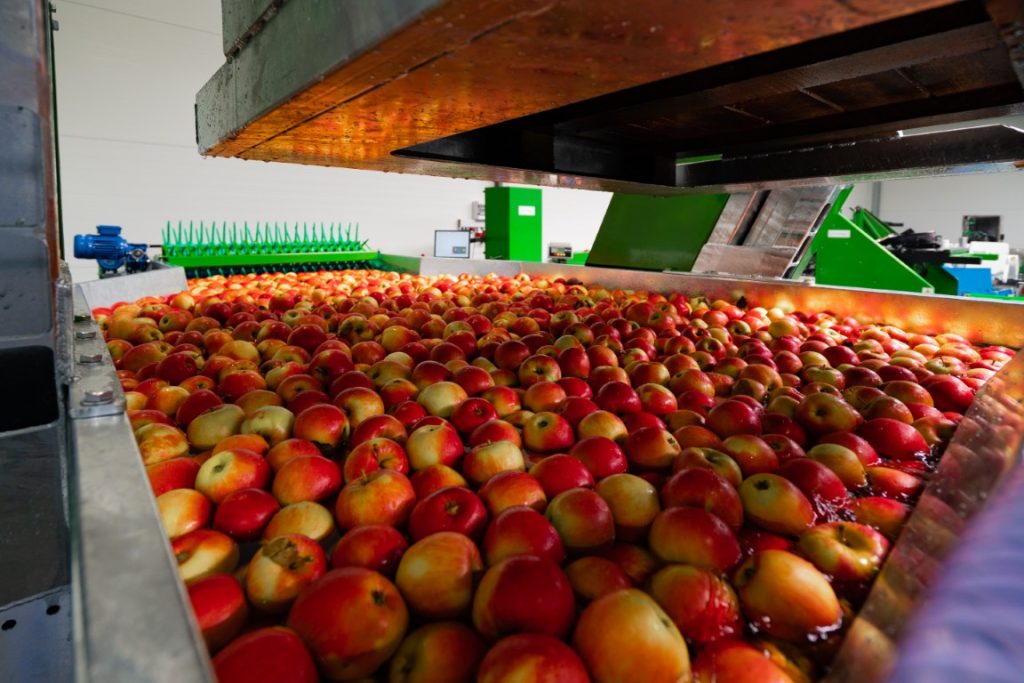
What water transport looks like in practice
In a modern water unloading system, the entire process is not limited to simply “putting fruit into water”. The key point is that fruit is introduced into the line in a controlled way.
A typical process sequence looks like this:
- the fruit bin is placed on the platform,
- the sliding frame lowers the bin into the water tank,
- once immersed, the bin is rotated so the fruit is released more gently than with a dry dump,
- the water pump directs the fruit toward the drying section,
- the pusher roller feeds the fruit onto the drying assembly,
- the drying sponges, and optionally fans, remove water from the fruit surface,
- after drying, the fruit is transferred to the next conveyor and to the sorter.
This controlled way of unloading the bin and guiding the fruit in water is one of the most important advantages over mechanical transport.
Why water unloading reduces damage
The advantage of hydrotransport does not come from one single factor but from the entire machine workflow:
- fruit does not fall suddenly from a height onto a hard surface,
- water absorbs part of the movement energy and cushions contact,
- soaking and unloading time can be controlled,
- flow toward the drying section is continuous, without sudden load spikes,
- the dryer prepares the fruit for further transport and sorting without excess surface water.
From a process standpoint, the most important point is that damage is reduced already at the line entry stage, where mechanical systems often generate the highest impact load on the fruit.
Advantages of water transport
- Reduced damage – water lowers point pressure and cushions impacts.
- Gentle bin unloading – fruit is not dumped abruptly onto a dry conveyor.
- Stable product flow – it is easier to maintain smooth fruit movement between line sections.
- Lower risk of hidden damage – fewer micro-injuries mean better quality after sorting and during storage.
- Better integration with the sorting line – after drying, fruit can be transferred gently to the sorter.
- Higher quality consistency – it is easier to maintain a stable batch standard at higher capacities.
If the goal is to reduce losses and maintain a high share of marketable fruit, hydrotransport usually offers a clear advantage over simple mechanical transport.
The role of the dryer – an often overlooked stage that also affects quality
Water transport does not end the process. After unloading, fruit must be dried effectively before being transferred to the next part of the line. In practice, this is done by a dryer equipped with sponges and, in some configurations, fans.
This stage matters for two reasons:
- it stabilizes conditions for further transport and sorting,
- it limits the problem of excess surface water before the next line sections.
In practice, a well-designed hydrotransport system is not just a water channel, but a complete setup: unloading, flow control, drying, and gentle transfer to the next stage.
Comparison: mechanical vs water transport
| Criterion | Mechanical | Water |
|---|---|---|
| Damage risk | high, especially at line entry | significantly lower |
| Bin unloading method | often abrupt | controlled |
| Pressure on fruit | point-based | reduced by water |
| Transport uniformity | depends on machine design and line transitions | high with proper flow |
| Impact on shelf life | more often negative | more beneficial |
| Final batch quality | more variable | more stable |
Conditions under which water transport works properly
Hydrotransport does not guarantee benefits automatically. To really reduce damage, the whole system must operate under proper conditions:
- stable and even water flow,
- correct machine positioning and leveling,
- no vibration or unstable floor conditions,
- reliable feeding of fruit into the drying section,
- proper drying before further transport,
- well-maintained working components and regular maintenance.
This is also important from an operational perspective. If stable line performance matters, it is worth preparing the equipment properly before the season starts:
How to prepare a sorting machine for the season.
When water transport offers the biggest advantage
Water transport is especially beneficial when:
- the line handles fruit that is prone to bruising,
- the facility aims for a high share of premium-grade fruit,
- the line runs at high capacity and losses must be reduced at high throughput,
- the product is intended for longer storage or demanding markets,
- quality must remain stable not only on the sorting day but also later.
In these applications, water transport is a standard solution in modern sorting lines. If you want to see how this type of system fits into a complete processing line, see also:
Fruit sorters.
Conclusion
Water transport is safer than mechanical transport not because it simply “replaces a conveyor with water”, but because it changes the entire way fruit is handled: from bin unloading, through product flow control, to drying and transfer to the sorter.
- less mechanical damage,
- lower quality losses,
- better post-harvest shelf life,
- higher premium-grade share,
- more stable overall line operation.
If a packing house wants to reduce fruit damage already at the start of the process, hydrotransport is one of the most logical and effective technological solutions.
If you want to look more broadly at how to choose a full line for a specific facility, see also:
How to choose an apple sorting machine.