


How does an apple sorting machine work?
Learn the stages of apple sorting and the technologies used in modern sorting lines.
What does apple sorting involve?
An apple sorting machine is a set of devices responsible for gently receiving fruit, separating it into individual positions, measuring parameters and directing apples to the appropriate outlets. In practice, it is not a single machine, but a complete technological line that combines transport, a measuring system, automation and fruit receiving stations.
Modern fruit farms use automatic sorting lines to classify apples quickly and repeatedly by size, colour, external quality and the requirements of a specific buyer. This makes it possible to prepare commercial batches with stable parameters, which is important for both domestic sales and export.
Examples of such solutions can be seen here:
fruit sorting machines.
It is worth remembering that sorting quality has a direct impact on fruit shelf life after harvest. This topic is described in more detail in the article:
how to increase apple shelf life after harvest.
What does an apple sorting line consist of?
The structure of a sorting machine depends on capacity, unloading method, number of quality classes and packing organisation. In most lines, however, several basic elements can be identified, each responsible for a specific stage of handling the fruit.
| Line element | Function | Importance for the process |
|---|---|---|
| Bin unloading | Gentle feeding of apples into the line | Limits mechanical damage at the beginning of the process |
| Water or mechanical transport | Transfers fruit to the next modules | Affects gentle handling and stable feeding |
| Fruit singulation system | Positions apples individually | Enables accurate measurement of each fruit |
| Measuring module | Measures size, colour and quality | Determines classification of apples into appropriate groups |
| Sorting outlets | Directs fruit to specific channels | Allows batches to be prepared by size and quality |
| Receiving and packing stations | Collect fruit after sorting | May be the main limitation of the real line capacity |
| Control system | Manages settings and line operation | Enables changes to quality thresholds, size classes and operating parameters |
The selection of these elements should result from the daily apple volume, the number of required sorting classes and the method of further packing. A line for large export batches requires a different configuration than a sorting machine used mainly for local sales or smaller farms.
Apple sorting process
A modern apple sorting machine works in several precisely designed stages. Each of them affects the final sorting result, fruit quality and the real capacity of the entire line.
Bin unloading
Apples enter the sorting line from bins. Gentle introduction into the system is essential to minimise mechanical damage that affects fruit quality and shelf life. Already at this stage, it is possible to decide whether the line will be based on water unloading or a mechanical solution.
For apples intended for demanding markets, reducing bruising is particularly important. That is why the unloading and transport method at the beginning of the line should be matched to the variety, fruit firmness and expected quality class.
Fruit separation
At the beginning of the process, fruit is separated and arranged in a single stream. This allows each apple to be accurately analysed by the measuring system. If apples enter the measuring module too densely or unevenly, sorting accuracy may decrease.
Stable fruit separation is especially important at higher capacities, because the camera and sensor system must be able to assess each apple individually. This is one of the reasons why the real capacity of a sorting machine depends not only on the measuring module itself, but also on the quality of fruit feeding.
Size measurement
Measuring systems determine the diameter, volume or weight of apples and assign them to the size classes required by the market. Size grade is one of the basic commercial parameters, so accurate size measurement has a direct impact on price and sales method.
Depending on the line configuration, sorting can be carried out using simple size ranges or more detailed parameter combinations such as size, colour and surface quality.
Quality assessment
Advanced sorting machines use camera systems and image analysis algorithms to assess fruit quality. The system can analyse, among other things:
- apple colour,
- shape,
- skin damage,
- surface defects,
- russeting,
- deformations,
- differences in colouring.
At this stage, fruit that could reduce the quality of the entire batch and shorten its shelf life in commercial circulation is removed. The scope of assessment depends on the equipment of the specific line and the vision system used.
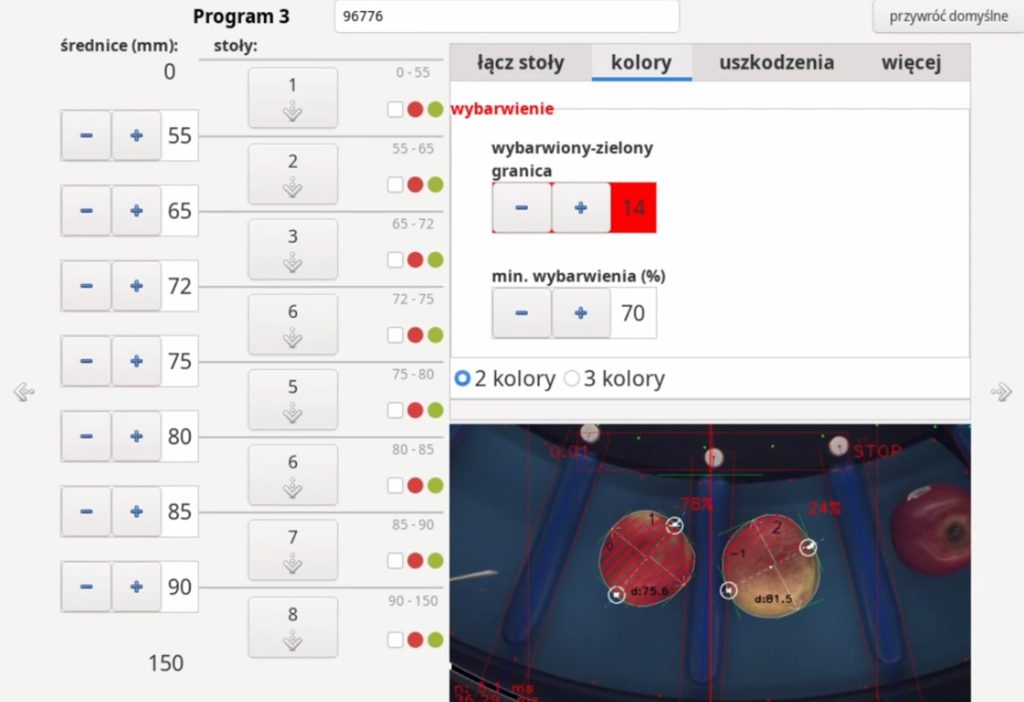
Directing fruit to the appropriate outlets
At the end of the process, apples are directed to the appropriate sorting channels. Each channel corresponds to a specific quality class, size grade or fruit destination. This makes it possible to prepare several product groups at the same time, for example dessert apples, fruit for further sorting, processing apples or batches intended for different packaging types.
Accurate directing of fruit to the outlets is important not only for the quality of the finished batch, but also for the organisation of receiving and packing work. Even a very efficient sorting machine will not achieve full throughput if receiving stations are not prepared to handle the right number of fractions.
Which apple characteristics can a sorting machine assess?
The scope of assessment depends on the technology used and the machine configuration. Basic sorting machines may focus mainly on size grade and weight, while more advanced systems use image analysis to assess appearance and apple surface quality.
| Parameter | What it means in practice | Why it matters |
|---|---|---|
| Size / grade | Division of apples by diameter or volume | Enables batches to be prepared according to buyer requirements |
| Weight | Assessment of individual fruit weight | Helps sort apples for specific packaging and commercial classes |
| Colour | Analysis of colouring and blush coverage | Affects visual attractiveness and quality classification |
| Shape | Detection of deformations or unusual shape | Allows fruit that does not meet commercial requirements to be separated |
| Surface damage | Detection of skin defects, abrasions and spots | Reduces the risk of weak fruit entering premium batches |
| Internal quality | Possible in selected configurations with appropriate measurement technology | May help detect some defects that are not visible from the outside |
Not every sorting machine assesses all parameters to the same extent. That is why, when choosing a line, it is necessary to determine which apple characteristics are actually required in a given farm or sorting facility. Production for the fresh market has different requirements than apples intended for processing, and export batches with high visual requirements are different again.
More information on matching the machine to production scale and farm requirements is described in the article:
how to choose an apple sorting machine.
What determines the capacity of an apple sorting machine?
The capacity of an apple sorting machine does not depend only on the operating speed of the machine. In practice, line throughput is affected by the entire process: from bin unloading, through stable fruit feeding, to receiving and packing the finished fractions.
Real sorting capacity is mainly influenced by:
- the number of lanes or working channels,
- the method of unloading and feeding apples,
- uniformity of the fruit batch,
- the number of quality classes and size grades,
- the number of sorting outlets,
- organisation of fruit receiving work,
- packing speed,
- the number of operators working on the line.
If unloading, receiving or packing is too slow, even a well-selected sorting machine will not work at full capacity. That is why, when planning an investment, it is worth analysing not only the machine itself, but the whole work organisation around it. This topic is described in more detail in the article:
how to increase apple sorting efficiency.
Does a sorting machine replace manual sorting?
An automatic sorting machine does not always completely eliminate human work, but it significantly changes its nature. Instead of manually assessing each fruit, operators supervise the process, receive sorted fractions, control quality and handle packing. This reduces dependence on manual selection and improves repeatability of results.
The biggest difference is stability. A person can assess fruit well, but with large volumes fatigue appears, decisions vary and it becomes difficult to maintain the same criteria throughout the day. An automatic system helps maintain constant sorting thresholds and prepare large batches of apples faster.
A sorting machine is particularly useful when a farm or sorting facility needs to regularly prepare repeatable commercial batches, work with large volumes or meet buyer requirements for size, colour and quality. With smaller fruit volumes, the decision to automate should be preceded by an analysis of costs, work organisation and planned production growth.
Advantages of automatic apple sorting
Automatic apple sorting provides measurable technological and economic benefits. The most important are greater repeatability, faster work with large fruit batches and the ability to prepare the product more precisely for the requirements of a specific market.
- significantly higher sorting capacity,
- high repeatability of quality,
- reduction of manual labour costs,
- better preparation of fruit for sale and export,
- longer batch shelf life thanks to removal of weak fruit,
- the ability to create many quality and size classes,
- easier control of finished batch parameters,
- fewer mistakes at high volumes.
In practice, this means greater control over product quality and the ability to meet the requirements of the most demanding markets. However, automation must be matched to the real needs of the farm. A line that is too small will create bottlenecks, while a line that is too large may remain underused for much of the season.
When planning the process, it is also necessary to remember about reducing fruit damage. Even the best sorting system will not improve apple quality if the fruit is bruised during unloading, transport or packing. More information on this topic is available here:
how to reduce apple damage during sorting.
When is it worth using an automatic apple sorting machine?
An automatic sorting machine makes the most sense when manual sorting becomes a production bottleneck or when buyer quality requirements are difficult to maintain without a constant measuring system. It is not only about faster work, but also about better control over which apples enter a specific batch.
It is worth considering an investment in a sorting machine if:
- the farm regularly sorts large quantities of apples,
- manual selection is too slow or too expensive,
- buyers require repeatable batches by size and quality,
- apples are prepared for export sales,
- there are large quality differences between batches,
- the company wants to reduce false rejects and sorting mistakes,
- production growth is planned in the following seasons.
Before making a decision, it is worth comparing the investment cost with manual labour costs, quality losses and limitations of the current process. The following article may also be helpful:
how much does an apple sorter cost.
Most common limitations in sorting machine operation
Sorting capacity and quality may be limited not only by the machine itself. In many cases, the problem appears in the organisation of work around the line: unloading is too slow, fruit feeding is uneven, there are too few receiving stations or there is not enough space for finished packaging.
The most common limitations are:
- feeding fruit too quickly without maintaining stable flow,
- mismatch between the number of outlets and the required number of classes,
- too few people at receiving and packing stations,
- lack of space for bin and packaging logistics,
- quality settings that are too general,
- sorting batches of very mixed quality without prior preparation.
That is why proper operation of a sorting machine requires not only good technology, but also proper process setup. In practice, work organisation often determines whether the line will achieve the planned capacity and whether the finished batch will meet commercial requirements.
Summary
An apple sorting machine works by combining several stages: gentle unloading, fruit separation, size measurement, quality assessment and directing apples to the appropriate outlets. Each of these stages affects the final batch quality, work efficiency and the possibility of preparing fruit for sale according to buyer requirements.
Modern sorting lines make it possible to increase quality repeatability, reduce the share of manual labour and better control commercial apple classes. However, the best result is achieved not by automation alone, but by a properly selected configuration of the entire line: from unloading method, through the measuring system, to the organisation of receiving and packing.
If you are planning an investment in an apple line, it is worth starting by defining the daily fruit volume, the number of required classes, the packing method and the expected quality of the finished product. On this basis, it is possible to select a sorting machine that will be not only technically efficient, but also practical in daily operation.