


How to calibrate a blueberry sorter
A practical guide to colour, firmness and learning program settings
How to calibrate a blueberry sorter (practical guide)
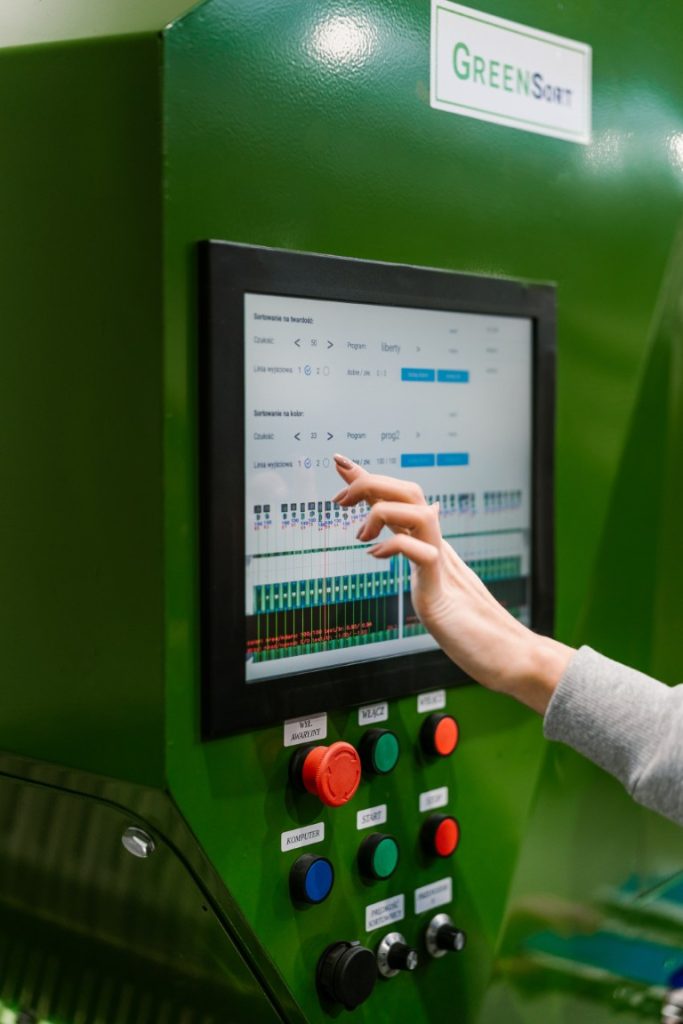
Calibrating a blueberry sorter is one of the key factors that determines sorting quality, machine stability and the overall profitability of the process. Even a well-chosen sorting line will not perform correctly if its settings are not matched to a specific batch of fruit.
In practice, calibration is not just about “setting up the machine”, but about choosing the right classification thresholds for the features the machine actually analyses. In Green Sort blueberry sorters, these are primarily parameters related to colour as well as internal and external defects. In addition, the system can operate in learning modes for soft – firm and coloured – normal.
If you want to better understand the sorting process itself, it is worth reading how a blueberry sorter works and learning more about NIR technology, which is responsible for assessing the internal quality of the fruit.
What does sorter calibration involve?
Calibration means preparing the machine to work with a specific batch of fruit and selecting settings that allow the system to distinguish as accurately as possible between acceptable fruit and fruit that should be rejected. In practice, the operator sets not only the sorting mode itself, but also its sensitivity, the learning program and the output lane for rejected fruit.
This means that properly carried out calibration affects several things at once:
- the quality of the marketable batch,
- the number of false rejects,
- line throughput,
- sorting cost per unit.
For the NIR 16 and NIR 32 models, nominal throughput is up to 400 kg/h and 800 kg/h respectively, but actual efficiency depends on whether the settings are correctly matched to the current fruit batch.
When should a sorter be calibrated?
- when changing the blueberry variety,
- when the quality of the fruit batch changes,
- at the beginning of the season,
- after changes in storage conditions,
- after machine setting changes,
- when the number of false rejects or quality complaints increases.
In practice, you should not assume that settings from one batch will automatically work for the next one. Differences in ripeness, moisture, colour development and firmness mean that the same program may produce different results for fruit that appears similar.
Which parameters are set during calibration?
In practice, the operator calibrates the machine mainly for two core operating modes:
- soft – firm,
- coloured – normal.
For firmness sorting, it is recommended to prepare a sample of good and bad fruit, meaning firm and soft berries respectively. For colour sorting, you need samples of normal fruit and fruit with visible colour deviations. In both cases, the system learns from the provided examples, and then the operator sets the sensitivity level.
Sensitivity is one of the most important parameters:
- too high sensitivity → more bad fruit will be rejected, but the number of good fruit rejected will also increase,
- too low sensitivity → less good product will be lost, but sorting effectiveness will decrease.
According to the operating logic used in practice, a sensible starting point for sensitivity is 50, followed by correction depending on the sorting results.
Step-by-step calibration process
1. Select the sorting mode
First, determine whether the current batch requires calibration for firmness or colour. In practice, this means selecting the appropriate learning program for the intended sorting goal.
2. Prepare a reference sample
For soft – firm sorting, prepare a sample of firm and soft berries. For coloured – normal sorting, prepare standard fruit and fruit with visible colour deviations. The sample should be representative rather than random.
3. Train the machine
The operator adds examples of “good” and “bad” fruit to the system and then runs them through the sorter view. This is the stage at which the machine builds its set of learned fruit examples.
4. Set sensitivity
After training the basic sample, sensitivity should be set. It is best to start with a middle value and then increase or decrease it depending on the number of false rejects.
5. Run a trial test
Next, run a small but representative batch of fruit and check whether the classification matches expectations. The key issue is not only how many berries were rejected, but whether the correct ones were rejected.
6. Correct the settings
Calibration is an iterative process. In practice, it usually has to be repeated several times: adjust sensitivity, test the sample again and compare the results. Only after several iterations do the settings become stable.
Learning programs – why are they important?
The sorter can store multiple learning programs. Each program is a combination of a set of learned fruit examples and the matching sensitivity setting. This is very important in practice, because different blueberry batches can vary significantly even within the same variety.
This makes it possible to prepare separate programs, for example for:
- different varieties,
- fruit with different storage conditions,
- colour sorting,
- firmness sorting.
This means that proper calibration does not rely on “constantly changing everything from scratch”, but on building the right program library and using it at the right moment.
Most common calibration mistakes
- overly aggressive settings that cause loss of good product,
- no recalibration for different fruit batches,
- too small or non-representative test samples,
- no control of results after changes,
- copying the same settings between different batches,
- leaving incorrect fruit examples in the learning set.
When sorting by colour, it is especially important to review the learned fruit examples and remove incorrect images. Otherwise, the machine may learn the wrong examples, which reduces sorting effectiveness.
These mistakes can significantly affect production costs, so it is also worth reviewing the differences between manual and automated sorting.
Calibration, throughput and process cost
Calibration affects not only selection quality, but also throughput and sorting cost. If the settings are too aggressive, more fruit is rejected even though some of it could still qualify as marketable product. If the settings are too loose, batch quality drops and the risk of complaints increases.
In practice, poor calibration can result in:
- loss of good product,
- lower batch quality,
- reduced sorting efficiency,
- worse use of the machine’s full potential.
That is why calibration is not just a technical activity, but one of the most important factors influencing the economics of the entire process.
Conclusions
Regular sorter calibration is essential for maintaining high product quality and efficient operation. Combined with a properly selected processing line, it can significantly reduce losses and increase productivity.
The most important thing is to treat calibration as a process based on data, testing and learning programs, rather than as a one-time setting. That is when the sorter can deliver its real potential.
If you are looking for the right solution, also check our blueberry sorting machines.