


How to reduce losses during blueberry sorting?
Where marketable quality is lost during sorting and how to reduce damage, rejection, and misclassification of fruit.
How to reduce losses during blueberry sorting
Losses during blueberry sorting do not result only from the fruit that ends up in the reject stream. In practice, the issue is broader: marketable fruit also loses value when berries are damaged on the line, when soft fruit is mixed into good batches, or when the classification system does not separate quality precisely enough.
For that reason, loss reduction should be analysed mainly from the perspective of the sorting process itself: transitions between line sections, fruit contact with machine components, classification settings, and the way fruit of lower quality is separated. This is a different topic from how to prepare blueberries for sorting and also different from how to increase blueberry sorting efficiency.
To reduce losses effectively, it is first necessary to understand how a blueberry sorting machine works and at which points of the process marketable quality is most often lost.
What loss during sorting means in practice
In practice, losses during sorting can be divided into three main groups:
- fruit rejected despite having marketable potential,
- fruit mechanically damaged while moving through the line,
- fruit misclassified into the wrong quality batch.
This distinction matters because not every loss looks the same. Sometimes the issue is overly aggressive rejection criteria. In other cases, the loss comes from fruit leaving the line in worse condition than it entered. The reverse also happens: soft or unstable fruit is not separated and reduces the quality of the entire batch.
Where the biggest losses occur during sorting
The biggest losses usually do not occur in one single place, but in several critical points of the process. Most often, these are:
- transitions between conveyors and line sections,
- drop zones and changes in the direction of fruit movement,
- areas where fruit-to-fruit contact becomes too intense,
- the classification zone, if sorting criteria are set incorrectly,
- the exit from the sorter and the transfer to packing.
Blueberries are sensitive not only to major impacts, but also to repeated small stresses. This means that even if the line does not cause immediately visible damage, the problem may become visible later as softening, poorer appearance, or reduced shelf life of the batch.
This effect is related to why blueberries soften after harvest, but here the focus is strictly on how not to worsen fruit quality during the sorting process itself.
Mechanical damage as a source of losses
One of the main sources of losses is mechanical damage generated while the fruit moves through the line. The problem does not have to mean complete crushing. In practice, losses are also caused by minor damage that is initially difficult to see, but reduces the quality of the batch after a few hours or days.
The risk increases especially when the line includes:
- drops that are too high between machine elements,
- sudden changes in the direction of fruit movement,
- hard contact surfaces,
- too many fruit-to-fruit collisions.
Reducing such points does not automatically increase line efficiency, but it does help preserve a higher share of marketable fruit after sorting. That is why line design should minimize unnecessary impacts and abrupt transitions between sections.
Misclassification also creates losses
Losses during sorting are not caused only by mechanical damage. Another major issue is misclassification, meaning a situation in which the system evaluates fruit quality either too strictly or too loosely.
In practice, two unfavourable scenarios may occur:
- good fruit is sent to reject or to a lower commercial grade,
- fruit of reduced quality is sent into the marketable batch and lowers its value.
Both situations mean losses, but in different ways. In the first case, you lose fruit that could have been sold at a higher value. In the second, you reduce the quality of the entire package or batch. That is why reducing losses is also about setting proper sorting criteria, not only about gentle transport of the fruit.
For blueberries, separating soft, damaged, or quality-unstable fruit is especially important. In practice, this may be supported by NIR technology if the goal is to assess parameters that cannot be reliably detected from external appearance alone.
How to reduce losses on the sorting line
Reducing losses during blueberry sorting requires control of the critical points of the process. In practice, it makes sense to focus on several specific actions:
1. Reduce hard-contact zones on the line
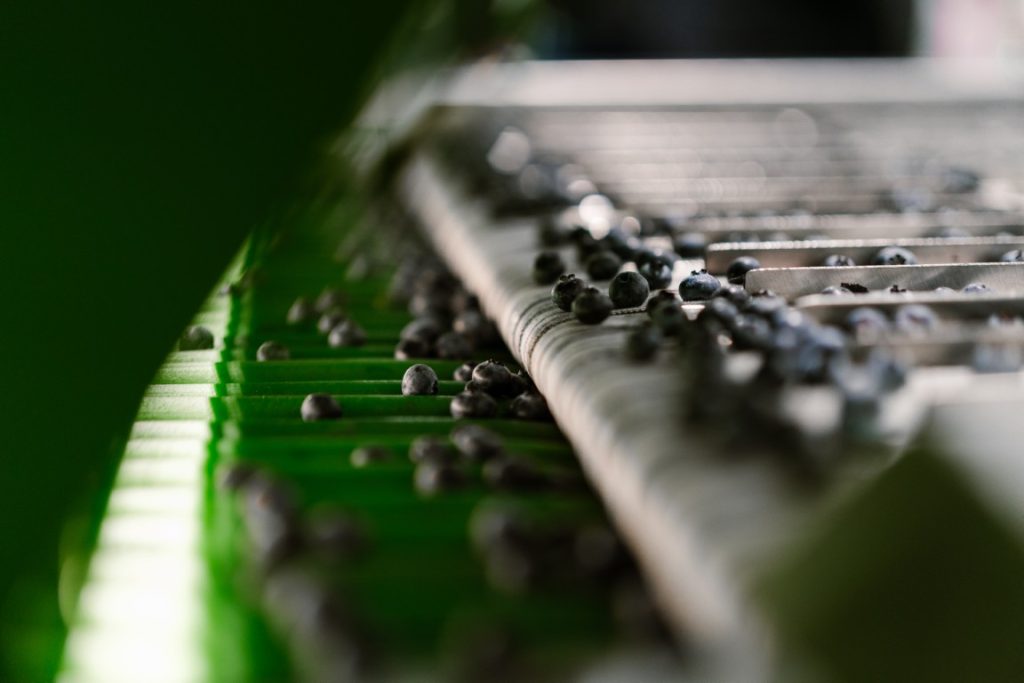
The fewer abrupt transitions, impacts, and hard contact areas, the lower the risk of micro-damage. A well-designed line should guide fruit as smoothly and gently as possible.
2. Reduce drop heights and the number of transfer points
Every transition between sections is a potential point of quality loss. Reducing the number of drops and discharge points helps lower damage without changing quality classification itself.
3. Match sorting criteria to the real quality of the batch
Settings that are too strict increase the number of rejected marketable berries. Settings that are too loose lead to mixed-quality output. The goal is neither maximum rejection nor maximum pass-through, but stable quality separation.
4. Separate lower-quality fruit before it affects the whole batch
The greatest risk to marketable quality comes from soft, unstable, or already damaged fruit. If such berries are not correctly identified, they can reduce the value of the entire pack.
5. Monitor not only reject rate, but also outgoing batch quality
A low reject level alone does not mean low losses. If fruit entering the marketable batch quickly loses quality, the problem is simply shifted further down the chain — to transport, storage, and claims.
Solutions supporting gentle fruit handling and precise quality sorting are used in systems such as Green Sort blueberry sorters.
How to distinguish preparation-related losses from sorting-related losses
This distinction is very important. If a batch enters the line already in poor condition, then the source of the problem lies before sorting. But if fruit enters the sorter in acceptable condition and leaves it with more damage or poorer quality separation, then the loss is being created by the sorting process itself.
That is why it is useful to separate three questions:
- was the batch properly prepared before entering the line,
- does the sorter worsen fruit condition during processing,
- does the system separate fruit by quality correctly.
The first of these topics is covered separately in how to prepare blueberries for sorting. Thanks to that, this article can focus only on losses generated during sorting itself.
Summary
The biggest losses during blueberry sorting usually come from three factors:
- mechanical damage generated on the line,
- incorrect quality classification,
- failure to separate fruit that is unstable in quality.
Reducing losses is not only about decreasing the amount of fruit in reject. The key is to preserve as much marketable product as possible without lowering the quality of the outgoing batch. That is why loss analysis should include both the way fruit is guided through the line and the accuracy of quality classification itself.